Early New Year's morning and Kubrick's 2001: A Space Odyssey on a major public broadcaster. Just like in the old days of New Year's Eve national television experience. The 2001 was the cream of the New Year's Eve programming until two decades ago, with the psychedelic cineastic experience of 2001 coming at some time around 3 AM, as a reminder of something "beyond". A strong reminder of the progress in time and advent of the long awaited 2001! With that real and forgotten 2001 almost a decade behind us, Kubrick's 2001 is not behind and it's not forgotten. It is beyond, with that strange sense of anticipation and advent. I am happy that 2001 is back, even if it's back for 2010. And, as if that whole experience was not enough, the New Year's party and the night after was crowned with Laza Ristovski's futuristic "Beyond the Horizon":
"Very well," said Utz. "I will eat eels. You will also eat eels?" "I will," I said. "There are no eels," said the waiter. "No eels? This is bad. What have you?" "We have carp." "Carp only?" "Carp." "How shall you cook this carp?" "Many ways," the waiter gestured to the menu. "Which way you like." The menu was multilingual: in Czech, Russian, German, French and English. But whoever had compiled the English page had mistaken the word "carp" for "crap." Under the heading CRAP DISHES, the list contained 'crap soup with paprika,' 'stuffed crap,' 'crap cooked in beer,' 'fried crap,' 'crap balls,' 'crap a la juive...' "In England," I said, "this fish is called 'carp.' 'Crap' has a different meaning.' "Oh?" said Dr. Orlik. "What meaning?" "Faeces," I said. "Shit." I regretted saying this because Utz looked exceedingly embarrassed. The narrow eyes blinked, as if he hoped he hadn't heard correctly. Orlik's wheezy carapace shook with laughter. "Ha! Ha!" he jeered. "Crap a la juive!...My friend Mr. Utz will eat Crap a la juive!" I was afraid Utz was going to leave, but he rose above his discomfiture and ordered soup and the 'Carpe meuniere.' I took the line of least resistance and ordered the same. Orlik clamoured in his loud and crackly voice, "No. No. I will eat 'crap a la juive'...!" "And to begin?" asked the waiter. "Nothing." said Orlik. "Only the crap!"
Graf Oderland pointed to a Guardian article by Natasha Chart, in which I felt a strong need for my "mediated reminder" in what I consider to be a drastic decline in the aesthetic of the language of the Left over the years. Commemorating the death of German student movement spokesperson Rudi Dutschke this day thirty years ago, I feel compelled to find a reminder of the once great and clear language of the Left.
Chart describes her disagreement at COP15 summit in Copenhagen with Naomi Klein’s use of term “reparations” as a damaging word because it calls up the idea of reparations for slavery in the US, which makes it impossible for the US to do anything referred to in that way. The word, as Chart points out, has become popular in some circles to mean getting wealthy nations to pay a responsible share of adaptation and mitigation support and to cut emissions, also referred to more neutrally as climate debt. What is a problem here is not so much the use of the word itself, but the environment in which Klein is using it, justifying it with a silly argument of “possibility” (“… you Americans have such a limited sense of the possible…”), as if the whole point is to test the possibility through words themselves. If the word makes an actual barrier in reality that is hard to overcome, is it then just too bad for the reality? But why are we at the summit then? To test the words? To test the language? Looking at how much was actually agreed to be done in reality, it could really be the case. I sense a barrier of a different kind than that which is usually used to describe global environmental policies. The barrier of language.
This is where I need the reminder:
Rudi Dutschke born Alfred Willi Rudi Dutschke (March 7, 1940 Schönefeld – December 24, 1979, Århus, Denmark) was the most prominent spokesperson of the German student movement of the 1960s. He advocated 'a long march through the institutions' of power to create radical change from within government and society by becoming an integral part of the machinery. This was an idea he took up from Antonio Gramsci and the Frankfurt school of Cultural Marxism. In the 1970s he followed through on this idea by joining the nascent Green movement. In 1968, he survived an assassination attempt, living for another 12 years until related health problems caused his death. Radical students blamed an anti-student campaign in the papers of the Axel Springer publishing empire for the assassination attempt. This led to attempts to blockade the distribution of Springer newspapers all over Germany, which in turn led to major street battles in many German cities. (Wikipedia)
The language of Dutschke was not the language that is testing itself. It’s the language coming from the structure of reality, from the scaffolding of the world in the need of change. The readiness of the language to act, to extend in the world like a limb, like an arm - the most important proof of its evolutionary nature, described by Levi-Strauss. Not the readiness to engage in a bickering in which you will deny somebody the sense of the possible - the possibility to extend. The true Left never denied the sense of the possible to anybody. It is a class sense! Part of the class awareness. The class is not defined nationally, unless we want the term to “slip” into an entirely different meaning in which we will divide the class into those who correspond with that?
Listen to Dutschke through the televised cigarette smoke! Inhale and exhale while the language develops. Reminiscent of the times in which words were used to connect, not to divide. Not the words of the Red, but the words of the Green - understood by the Global South and the Global North.
1969 Yugoslav-German-Italian-American film "Battle of Neretva", directed by Veljko Bulajić, was shown last week in prime time on Croatian national television (HRT), and it reached higher ratings than the UEFA Champions League soccer on other television channels. Battle of Neretva was seen by 16 percent of viewers, while Juventus-Bayern match scored 10,7 percent. (E-novine)
Battle of Neretva was nominated for the Academy Award for Best Foreign Language Film in 1969. This film is the most expensive motion picture made in the SFR Yugoslavia, starring Yul Brynner, Orson Welles, Sergei Bondarchuk, Curt Jurgens and Franco Nero, among the international crew. It was nominated for an Academy Award for Best Foreign Language Film, the year after Sergei Bondarchuk (playing the role of Martin in Neretva) won the honour for War and Peace. The English language version features a powerful score by American composer Bernard Herrmann. One of the original posters for the English version of the movie was made by Pablo Picasso, which according to Bulajić he did without payment, only requesting a case of best Yugoslav wines. (Wikipedia)
The Battle of the Neretva (Serbo-Croatian, Croatian, Serbian, Bosnian, Bitka na Neretvi), codenamed Fall Weiss, was a German strategic plan for a combined Axis attack launched in early 1943 against the Yugoslav Partisans throughout occupied Yugoslavia during the Second World War. The offensive took place between January and April 1943. It is named after the nearby river, the Neretva. The operation is generally known as the Fourth anti-Partisan Offensive, while it is also known as the Fourth Enemy Offensive (Četvrta neprijateljska ofenziva/ofanziva) or the Battle for the Wounded (Bitka za ranjenike) in ex-Yugoslav sources. (Wikipedia)
I watched the film on HRT last week, while I was running a slight fever from a flu, and, although I watched it before, this time it was different! Perhaps it was some psychedelic side effect of Paracetamol, but it was very clear, direct, almost immediate! It was a normal analog signal, but the image was very sharp. Combined with the very direct and short dialogues of a war movie, it produced a great "reminder" and directed the viewers' attention to the human plain of the battle for the wounded partisans. High viewer ratings also indicate that a sharp and energy-laden broadcast of a visual monument and mediated reminder, that this film most definitely is, can easily cast the shadow on the mass produced entertainment event such as soccer. Croatian viewers, usually in a strong soccer frenzy, are a an excellent example.
Yul Brynner was and still is my favorite in the film:
Recent student protests in Zagreb and Belgrade put forth the same proposition; free higher education. Not free as in freedom, as I hoped, but free as in “free beer”. Although I support the students in their protest against the society that has turned everything upside-down, I feel that there is a lack of something in students’ demands, and that has to do something with this “free as in freedom” thing that Richard M. Stallman coined for Free Software Foundation and “free as in free beer”, where the student requests mostly ended up. I do not intend to make some logical common ground between the Free Software Foundation and student protests in capitals of Croatia and Serbia, but there is a striking similarity between what happened with development of GNU (GNU’s not UNIX) as a entirely “free as in freedom” computer operating system and with the rise of Linux, as something that is similar, but not entirely what it was supposed to be, and closer to “free as in free beer” or better to say “free as in one free beer”. The level of freedom that Richard Stallman envisioned for GNU exceeds the level of freedom intended for Linux by Linus Torvalds many, many times. Due to the need to dumb the concept down to the level where it would be understood by all programmers as something viable, it was necessary to take the latter path. The whole story of GNU and Linux is explained HERE.
The demands for free education by University of Belgrade and University of Zagreb students equally stressed the fallacies of Bologna Declaration and standardization of higher education at the European level. This is true in my opinion. Recent student protests in Germany showed the same problem of turning higher education in something more similar to trade schools, trying to enroll as many students as possible to cover the expenses. But this is a question of quality, raised by Germans. The question raised by students in Balkans is the one of quantity - something where the idea of a free and open operating system is replaced by an idea of something that is supposed to run free of charge, as a combination of free and proprietary, released under various licenses, just enough to keep it running. It is a question of quantity and dispersion, rather than quality and integration. The expressed desire here is to have a free operating system of higher education that will use a very proprietary Bologna Declaration as a framework for duration of study and formal study requirements, where there will be a constant need to push students through college in order to satisfy the statistic of the “society of knowledge” paradigm – which is very corporate and proprietary in the core, connecting European higher education to corporate needs.
There is also a very obvious credentialist tendency present here, with the expressed student demand to lower the threshold for entry in graduate studies and to get master’s degrees in the undergraduate cycle of study, which initiated the student protests in Serbia a year ago. Now, this has nothing to do with free education! This is a very open abuse of the philosophy behind the free operating system of higher education. Using images from the past in mediating the reminders (mediated reminder!) from the 1968 student protests through Che Guevara t-shirts and anarchist symbolism, is the same misconception as thinking that you’re one step closer to freedom when using some of the latest Linux distributions with non-free software included. These are dead reminders, because they don't remind anyone of the essence of 1968 student struggle for humanized higher education in the world. The request should then be “education at a lower cost”, not “free education”. Czech Republic has good higher education at a low cost. If we are talking about the freedom, we are talking about the free operating system in its entirety. If you want to be free from the commercialization, refuse the Bologna Process as a process of commercialization! But how will it be possible to finish school earlier, with less work, with continuous testing and without integral oral exams after the course, and get into graduate school immediately? It will not. How will it be possible to shut up the teaching assistant, lecturer or professor with sheer ignorance, lack of interest for reading and that mean and silent threat of teacher evaluation? It will not be possible! The free operating system is free in its entirety and the teacher is free as well.
C.D. Broad said it best:
"It is to be feared that Spinoza would not have been enlightened enough to appreciate the beneficent system of the Ph.D. degree, introduced into English universities as a measure of post-war propaganda, whereby the time and energy of those who are qualified to do research are expended in supervising the work of those who never will be."
The third film in the "mediated reminder" connection (now it's a connection, like the French Connection) is "The Seventh Continent" by Dusan Vukotic. It's a 1966 Yugoslav-Czechoslovakian feature film in which a group of children discover the new continent of the world, uninhabited by adults. Soon, many other children are joining them in that new paradise, leaving their parents and other adults baffled on all remaining continents. (IMDB)
This is a film with a strong message of internationalism and solidarity, not in its dialogues but in its perfect imagery in Eastmancolor, which makes it a great cinematic piece. But, there is a problem with this film. It is nowhere to be found! If Graf Oderland can't find it somewhere in NYC, I'm sentenced to living in a memory of a great movie that I saw only once in a cinema as a kid, without seeing it again. This may lead me into making all sorts of constructions and fantasies in my quest for the holy mediated reminder, and I may miss the point!
Besides making this feature presentation, Vukotic was the most significant representative of Zagreb School of Animated Film. He won many prizes, including an Oscar for best animated short in 1961 for Surogat ("Ersatz"), being the first foreigner to do so. Another of his films, Igra ("The Game"), was nominated for an Academy Award in 1964. (Wikipedia)
At least "The Surogat" and "Cow on the Moon" can be seen online:
These days a friend of mine, German sociologist Bodo Weber, published a very important article about the looming political disaster and very possible outbreak of ethnic violence in my country. Bodo is an area expert for Balkans and a senior associate of the Democratization Policy Council - a global initiative for accountability in democracy promotion. This article is one of the few remaining calls for solidarity on a larger scale and for a joint effort to correct the errors made by international politics in Bosnia. Solidarity through understanding and awareness is what Bodo advocates, and I am grateful for a voice that tries to understand the planetary human trapped in the vicious circle of ethnic interpretation of Bosnia's problems – which is the European interpretation, and now also a part of a growing «the hell with it» sentiment in American foreign policy. It is important to see that this call for understanding has a history. Deeply rooted intellectual history, connected with the problem of Europe as whole, and Europe aware of the world.
In the 1990s Bodo was the editor of the German student magazine «Perspektiven» from Frankfurt/Main, which saw the light of day some time in 1989. It covered the topics of the emancipation movements in Asia, Africa, and Latin America. The attempt of editors was to promote the feeling of international solidarity among students, especially for «adequate distribution of wealth».
What serves here as a reminder is the editorial from the first issue.
"So versteht sich PERSPEKTIVEN auch als Forum für eine Wiederaufnahme der Diskussion um den Internationalismus-Begriff, dessen Konturen seit den späten 70er Jahren zunehmend unscharf geworden sind. Die Arbeit der Redaktion läßt sich von der festen Überzeugung leiten, daß Chancen auf Änderung nur dann bestehen, wenn auf breiter Ebene die unmittelbaren Zusammenhänge zwischen schier grenzenlosem Wohlstand und entwürdigem Mangel bewußt gemacht und in der Folge endlich die überfälligen politischen und wirtschaftlichen Konsequenzen gezogen werden."
Which, roughly translated, is:
«Perspektiven are understood as a forum for reinstatement of discussion about the reach of internationalism, whose shapes have become blurred since the late 1970s. The editorial work is led by a belief that the chances for change exist only when the direct relationship between seemingly unlimited wealth and disgracing deficiency is made aware at a larger scale, leading eventually to political and economic consequences.»
Source: Perspektiven, Editorial 1/2 1989, 2
«...whose shapes have become blurred since the late 1970s.» This is an important meme, and there is a deeper meaning to it. Not only in terms of the paradigm change at the end of 1970s, but in terms of awareness and solidarity at a larger scale. Was it first lost in theory or in practice? This meme was a mediated reminder in 1989. It resonated back then and it resonates now. It is a part of the awareness that things were different beyond one point in time, the gestalt of which is blurred, somewhere on the horizon of history. I am still unable to find anything deeper than these mediated reminders, which I have introduced in my previous posts as a category in a lack of a better reference, but there is an entire language behind them. This is not apophenia. There is a planetary language behind this! Traces of this language are in the call that Bodo made. Is there anybody to read between the lines and recognize it? Or at least become AWARE of it?
Returning to Graf Oderland's post on Colin Wilson and «peak experiences», I am followed by some deep sense of continuity underlying the blog topics. My recent posts were a sort of reminder for achieving the peak experience. As Wilson puts it, this is a "deep, intense flash of meaning that is easily forgotten the next morning." And it is the case that many of my flashes have faded over night. This I can attribute to layers of factual and historical knowledge in which I oppose the notion of the underlying structure of pure life. Life as an idea, complete in itself. I am aware of this when I think of my factual and historical completeness in the passage of time. It is as if there are two separate individuals, of which one is always the same, and the other one succumbs to the creation of factual and historical superstructures. I do not mean this as assuming some existentialist pose, but more as an awareness of the possibility to return to the actual state of happiness. Individual happiness! This is a mental process, if I understand Wilson, that can be induced voluntarily and can act as a reminder of real, ahistorical life. However, this did not come to my mind until I posted recently on "That Man from Rio" and "Contempt" films. This I understand as a "mediated reminder" for the peak experiences. Another role for the work of art relating to the underlying structure that helps us understand the completeness of being. And this is when it does not fade over night! This understanding comes from a universal language, which I am growingly eager to learn, but more importantly, which I am not afraid to acknowledge, despite my factual and historical self.
It's like Nietzsche said, books will fall off the shelves into your hands. After the last post, I remembered Jean-Luc Godard's 1963 film "Le Mepris" (Contempt). Contempt was shot partly at Casa Malaparte in Capri, designed and owned by Italian writer Curzio Malaparte, which is more a sundeck than a house. Casa Malaparte is the object of artistic worship and it is no wonder that you can find the abundance of data about it. But, there is rarely an opportunity to experience the experience of the Casa Malaparte that happened at one particular moment in time. There's a YouTube video that somebody made, with exactly those moments in the movie when Brigitte Bardot walks on the sundeck, with the roof lines stretching to the blue horizon of this cineastic structuralist plain extending above the Gulf of Salerno. Like with Jean-Paul Belmondo in Brasilia, in these sequences the moment in time with the work of art will outlast the work of art itself. This intention is obvious in the film. Were the 1960s more patient with their moments or was it something that was found back then, the underlying structures that were supposed to connect the world into a single experience of the planetary human and extend to the horizon?
Casa Malaparte was abandoned and neglected, later renovated. Regardless of its previous or current state, there is one permanent state of that architectural marvel that will never change, and that is the state of its moment in this cineastic human time that stretches indefinitely. This is the feature of one particular era where the film camera had an eye for it, there was a special lens - some strange naïveté towards the structure. Open and uncritical of the existence of something underlying the time and space of the planetary human.
My God, I can't believe that Oscar Niemeyer is still alive and still involved in diverse projects! He was born in 1907! One can say that the glory of the work of art outlasts the glory of the artist. But in the case of Brasilia, as the capital work of art of Kubitschek, Niemeyer and Lucio Costa, situation is somewhat different. The vision of human in artist's mind at that particular point in history, which are the wonderful structuralist 1960s, will outlast the work of art. A sequence of scenes in 1964 movie "That Man From Rio" with Jean-Paul Belmondo was shot in Brasilia, and the perfect photography in that movie captured the movement of the human body through the architecture like never before and never after! Editing played its role, but there is something in the movie that brings that strange feeling of nostalgia for large-scale human projects. The socialist city is still there to remind me of the roads less travelled. "That Man From Rio" is one of my childhood favorites, but more as a proof in favor of Baudrillard's claim that only the child knows that there is no childhood. What I know now I knew back then! I want to run on the great structuralist plains in the City of the Sun.
Back on this blog after more than a year! I apologize to my co-blogger for missing that last post from September last year. Technology confuses me a little, and I tend to get totally distracted by something that's new and interesting. I began tweeting on Twitter early this year, and later turned to FaceBook, because that's where the action is. However, that does not mean that I have to totally disappear. Graf Oderland showed some of his fabulous writings here. To honor that, I will continue posting. My co-blogger is blogging elsewhere, but we'll surely meet again here.
I don't know if you're following the ongoing political campaign here, as it becomes more impervious to satire with each passing day (some brilliant tactic, no?). But you really need to watch this comedy bit, which aired on the venerable Saturday Night Live this past weekend.
A little background, since I don't know if you got acquainted while you were living here; SNL has been around since the mid 1970s, and since maybe the second episode aired it has been strictly de rigeur to talk about how it has really gone downhill, how it's not funny (at least 60% of the time, it isn't) or just downright bad, how it was so much better in 1977/1985/1983/1996/2000/whatever, and the show should really be mercifully killed off. The cast rolls over with the years, and while most people talk as if the current players suck when they are on the show, when they leave they are thought of as legends. Well, some of them, anyway. Even when most go on to a career of really bad moviemaking and dull sitcoms.
Strangely enough, being a (sometimes) live comedy show running late at night, SNL still has the potential to move the public needle like few other things in this age of hyperpluralized media. I mean, I don't know who sits down and watches the 7 PM national news to get their info and views anymore. I sure don't.
The SNL parody of the first Palin interview, from two weeks ago, is here. It's also pretty good. And the comedian playing Palin - well, she's not actually on SNL anymore, though she was for years, as a writer and performer. She's well-known enough as a sort of babe for intellectuals and model for smart girls - the glasses, the glasses - that most people figured she'd be brought back after Palin was chosen, given the obvious resemblance.
You know, what's amazing and funny, in fact downright magnificent (and you may catch it, depending on how inundated you've been with the few cryptic and comically inept statements this woman has graced us with) is this; the high point of the comedy, right in the middle of the skit, isn't comedy writing at all - it's taken right from the original interview our dear VP candidate gave last week.
Apropos of nothing, but for the fact that I ran across it today just as I'm thinking of turning up my blog production (here and in other places), here's a story on how the Information Economy is killing people.
A couple weeks ago I chatted with you about Colin Wilson – I didn’t know if you’d heard of him.Lately I’ve been reading some of his work – of which there is a ton, on subjects ranging from philosophy to crime to the occult and paranormal.(In fact it is always interesting to me how I “discover” new authors and new works either by chance or by following a string from one that I like to one I’ve never heard of; this is how I’ve come upon some of my biggest influences.Take Frisch, for example – my introduction to him came when I happened upon a movie adaptation of one of his novels on TV one evening.)In the case of Wilson, somewhere along the way I found part of an essay he wrote on a favorite author of his (and mine) – Musil (and here it is.)That was a couple years ago, but I kept him in the back of my mind and recently decided to do a little reading up.
You can get a lot of stuff on Wilson at this site.Now in his mid 70s, he is still industriously churning out books, and as far as I can tell, still on the fringes of British literary circles, which I assume is just fine with him.But (so the story goes) in the mid 1950s, he went from being a self-educated Midlands lad, sleeping rough on Hampstead Heath and doing research in the British Library to literary celebrity overnight with the publication of his book The Outsider.Reading it right now, I can only think it must have been some world in which an eclectic, non-dumbed-down exploration of existentialism could make a writer famous.I cannot conceive of it now.But you can read plenty about it via the link above in other places; to put it briefly, he was cast by the press as one of the “Angry Young Men” of that moment.Of which he wasn’t.The backlash against them and him inevitably came (as it always must in Britain), and he took to the hills, so to speak, and back to work.
Maybe it’s no surprise that he remains utterly convinced of his own brilliance to this day, and of the lasting worth of his “New Existentialism” as a way of living, as laid out in his six-book Outsider cycle.Far be it from me to try and boil him down to a sentence or two, but here goes: he levels his attack upon Sartrean-style existentialism, and upon the whole pretext of much modern philosophy and culture, which is the assumption that life is basically meaningless.He refuses to believe this – regards it as psychologically sick, in fact - which is probably what infuriates so many in the intellectual set, and why I am attracted to reading him.There’s much more – his oeuvre is far too diverse and idiosyncratic to pigeonhole, which also makes him difficult to estimate.He entertains – apparently, even subscribes - to some of the more out-there notions having to do with prehistoric alien visitors and the whereabouts of Atlantis (I wonder about his thoughts on Hyperborea!); he has fixated on crime and criminology to the point that it seems like a bit of an obsession, and neither here nor there, he is open in his autobiography about his fetish for wearing women’s underwear.Well, to each his own.
I started reading Wilson not at the most obvious place – The Outsider, the book that made him suddenly, if momentarily famous – but with a book he wrote in the early 1970s entitled New Pathways in Psychology.It’s an unusual book, focusing on the work of the psychologist Abraham Maslow; you probably know him from his hierarchy of needs.
It seems that Maslow and Wilson carried on a correspondence, and it’s relatively easy to see how their interests and views on the psyche converge (more on that in a second).The first third of the book is an analysis of philosophy and early psychology, from Hume (whose skepticism Wilson is intensely skeptical of) through Freud and his contemporary followers like Jung and Adler, all of whom eventually made crucial breaks from “that Viennese quack” (copyright Vladimir Nabokov).The second part is a biography of Maslow himself, and the third section surveys some of the (then-contemporary) psychological theories inspired by or compatible with Maslowian psychology, especially Frankl (Man’s Search For Meaning).
Wilson’s interpretation of Maslowian psychology (and all psychology, for that matter) is interesting, first because it comes from an iconoclast and very literary one at that.Like much of his other work, this book is shot through with literary and historical examples, which makes it an accessible read to a bookish type like me.It is also clear how Maslow’s and Wilson’s respective tracks could make a common ground between them.I won’t spoil The Outsider for you, except to say that it stems from Wilson’s interest in a common, if not identical feeling of “world-failure” among artists and thinkers from the 19th century Romantics to 20th century Existentialists, and the consequent loss of life’s meaning they felt (without old, bourgeois standards or religious certainty to fall back on – they rejected those).The very top of Maslow’s pyramid, you may remember, is “self-actualization,” which is the plane of creativity and inspiration and self-possession. The discovery of a higher, objective meaning!The fleeting, fiery moments of ecstatic glory (often amidst terror or crisis) that Romantic poets rhapsodized about, or the experiences of strange, indescribable meaningfulness felt by Sartre and Camus’s existential heroes – those have the characteristics of Maslowian “peak experiences,” according to Wilson.
Only they did not have the psychological understanding to know that at all.They were left to understand it as “inspiration” or “the muse” or something else entirely random. One of Wilson's points in The Outsider is that these outsider figures - such as Dostoevsky, Hesse, Hemingway, Van Gogh, Nijinsky - saw more and saw more deeply than the rest of the world, but after that, had a hard time answering the question "How to live?" No wonder they grew despondent when the ecstatic feeling passed, suffered tremendous mood swings chasing down “experience”, and often died young.You would too.
The other thing I can see is that it presages by some decades the positive psychology movement, which is now ensconced in the academy and in popular thought, as well as Czikszentmihalyi’s “flow” theories, which are related and which also have a lot of currency today. A few assertions to be drawn from Maslow and Wilson, summarized as best as I can:
- The whole discipline of psychology post-Freud went out of whack because it concentrated only on bringing the pathologically mentally sick back to “normal,” instead of understanding the mind-ways of the most mentally healthy, fulfilled and resilient. (a firmly Maslowian point.)There was and is a need for study of the happiest, those whose mental economies are booming, so that we might understand what was going on and how others could be brought up to that higher level.
- “Peak experiences” can be cultivated and created at will (or close to it), and learning how to do this is the next important step for mentally healthy human beings to make.Will – the sustained effort of will – is vitally important.As is attention.As is attitude.
- We human beings are at our happiest and closest to “peaking” when our “mental pressure” is up, when we are pushed and/or pushing ourselves to our capacities, whether by external crisis or by deliberate acts of will.That is why we “lose ourselves” in times of incredible stress, and discover abilities and strengths we didn’t know we had.It is necessary to keep that mental pressure up, by force of will and attention (if our external surroundings don’t pressurize us enough.)
- Mental and physical health are tied together, and the ribbon is perhaps attitude.Wilson refers several times to Frankl’s famous story about a fellow prisoner in the concentration camps, who dreamed he would be released on a March 30th, and grew increasingly excited, till the day came and passed, and he died of despair the next day.Likewise, the more physically exhausted and unhealthy a person is (that’s day-to-day existence for a great many people in this world), the less likely it is they can summon up the will and the energy needed to induce those “peak experiences.”
As someone interested – no, I’d now say obsessed – with creativity, the muse, and figuring out how to live a life of relative, sustained happiness and creative work, I find this stuff compelling.I’ve read a lot of the popular literature on positive psychology and “flow” and it generally all fits together.What I get from Maslow is usually what I also get (in a more pop-psych form, perhaps) from today’s positive psychologists.On a totally different tack, I’ve thought about this, and the soldier friend you talked about – how it could be just as applicable to those in much more dangerous places than I ever go, maybe more so.Wilson draws upon William James, noting that one of his essays is on the subject “The Moral Equivalent of War”: “he can get no further than to say that we must find intellectual and spiritual activities to bring out the warlike virtues of courage and bravery in us.”But who needs the “intellectual” and “spiritual” in that sentence?There is plenty of the real thing, which functions just as well if that is what you choose.
The thing about all this “peak” and “flow” – the arguably amoral thing – is that a person can legitimately find “flow” robbing a bank or sacking an enemy town or just existing on that edge I suppose you must live on in a war zone, as much as he can painting a painting or writing a sonnet or just washing the dishes, zen-master-like.(Czikszentmihalyi does make the point in one of his books that true “flow” experiences go towards some redeeming purpose…but why should they, other than for moral reasons?)If this is indeed a feature of the human psyche, that such mentally satisfying experiences need not always be altruistic or even good in nature (and I think it is true) then it seems a little harder to be terribly idealistic about peace – or at least, about collectively intellectualizing our way towards peace.As much as we would like that to be possible.
So via email I’ve sent you a file with passages I’ve copied out of NPIP (it’s my customary way of taking notes).There’s a ton of other stuff in there that is just as interesting, but that I missed.
For instance, here is Wilson talking about what he called “the robot”:
“…I elaborated this theory of the automatic pilot, speaking of it as ‘the robot.’I wrote: ‘I am writing this on an electric typewriter.When I learned to type, I had to do it painfully and with much nervous wear and tear.But at a certain stage, a miracle occurred, and this complicated operation was ‘learned’ by a useful robot whom I conceal in my subconscious mind.Now I only have to think about what I want to say: my robot secretary does the typing.He is really very useful.He also drives the car for me, speaks French (not very well), and occasionally gives lectures in American universities.
He has one enormous disadvantage.If I discover a new symphony that moves me deeply, or a poem or a painting, this bloody robot promptly insists on getting in on the act.And when I listen to this symphony for the third time, he begins to anticipate every note.He begins to listen to it automatically, and I lose all the pleasure.”
Later:
“The robot is necessary.Without him, the wear and tear of everyday life would exhaust us within minutes.But he also acts as a filter that cuts out the freshness, the newness, of everyday life….in developing the robot, we have solved one enormous problem – and created another.But there is, after all, no reason why we should not solve that too: modify the robot until he admits the necessary amount of ‘newness’, while still taking over the menial tasks.”
The key, it seems, is to gain control of this robot, to not let it run amuck in our lives.This is “mindfulness,” in other words, and that concept is thousands of years old.Yet most people let their robot run most or all of their lives, and that is the source of much unhappiness.The part about “modifying the robot” points at nothing less than psychological evolution, which is in fact an assumption that Wilson (and Maslow) would make – that the human psyche is capable of evolving and improving through time, learning and effort.That we have not even come close to maximizing its potential.The whole point of this psychological outlook, and of this “existentialism” is that there is a way to do so; as Wilson quotes Huxley on Freud, it’s something to the extent of, if the psyche has a basement, must it not also have an attic?
Here's a little Colin Wilson on peak experiences, on Youtube:
Friday, January 18, 2008
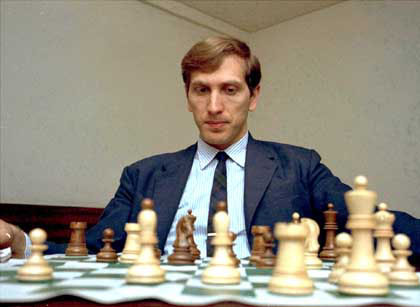
In Memoriam: Robert James "Bobby" Fischer (1943 - 2008)
The legacy of yesterday deceased chess grandmaster and world champion Bobby Fischer is remarkable in one particular aspect that the media do not recognize, and it is his engagement in non-aligned countries, especially in former Yugoslavia, the country of his choice for the 1972 world championship match with Boris Spassky. Although the actual match took place in Reykyavik, Iceland, with Fischer winning the title, the controversial 1992 re-match eventually took place at Sveti Stefan island in Montenegro and in Belgrade, Yugoslavia. Fischer’s refusal to obey instructions from the US Department of Treasury to drop participation due to US sanctions towards Federal Republic of Yugoslavia was the main reason for his subsequent life as fugitive for the US authorities and asylum seeker in several countries, of which Iceland granted him one in 2005.
Fischer’s visits to Yugoslavia in 1958, 1968 and in the seventies were given great attention by the Yugoslav media in terms of welcoming a western sportsman and intellectual who is supportive of the goal of Non-aligned Movement that Yugoslavia who, with president Josip Broz – Tito at the time, was a prominent and leading member country. After the refusal to accept the communist “Soviet way” in the early fifties, the Non-aligned Movement gave a chance to Yugoslavia to establish a historically important communication of one European country with the “third world” in the process of decolonization. Fischer’s visits to Belgrade, flooded with students and intellectuals from non-aligned countries were a critical point that made obvious that the “capitalist block” communicates very well in terms of the universal language such as chess. “Game of intellects” in the field of natural sciences and universal languages (with heavy accent on learning the new universal language – Esperanto) was a concept very much regarded in the socialist (not communist) Yugoslavia, where the late Marxism in the sixties acquired the critical mass in architecture, industry, culture, and in support to similar socialist projects in the world. On the political scale, the support was give to the emancipation of undeveloped countries in Africa and Asia, including the controversial Palestinian question. The academic and cultural exchange with Palestinians reduced the diplomatic relations with Israel to almost a zero. Bobby Fischer’s appearances in events sponsored by the Communist Party of Yugoslavia or by any state instance deemed to be supportive of either Vietnamese or Palestinian liberation movements, was perhaps the incentive for creation of his image as “anti-Semite”, especially bearing in mind that Fischer himself did not wrap up much what he had to say.
So, without further speculations of what might have been the cause for his alienation from the world that he came from, these lines are in the memory of a man who was expected to come to my home town at one occasion in the seventies, but due to appendix problems, he cancelled his visit to a chess championship here. Too bad, his visit could have spawned off some anecdotes…
A little revelation for me today. I finally found a song that I was whispering from time to time, without knowing the title or who the artist is. And yes, it has dawned on me, thanks to my friend Rade who is a meticulous seeker of pop culture stuff on the Internet. It is Jeff Wayne’s “Eve of the War”! Big thanks. You know, this is really a situation where search engines don’t help. How are you supposed to enter a keyword for something that you can only reproduce as music. Is this a good idea for an innovative search engine? Probably not.
There’s one thing that connects me strongly to this song. It was used as intro to a 1980’s Yugoslav sci-fi review show “Zvezdani ekran” (“Starry Screen”) hosted by Zoran Živković, the leading authority on science fiction in former Yugoslavia, later a big friend of Michael Moorcock and the most translated Serbian writer.
I watched the show in 1985 and 1986 usually some time at noon, before the school. I am sorry that the recorded shows are nowhere to be found, otherwise I would put the whole intro here, not just the music. The one below is from an animated series.
Yes, mid-eighties Graf! That was the time of those BBC documentaries, ones from Thames production. Wildlife shows like “Survival”. David Bellamy and wanders of nature somewhere around 10AM and then Zvezdani ekran. It was in that show that I saw a short sci-fi film "Quest" by Saul Bass based on a story by Ray Bradbury of the world where people live for only eight days and try to get out of that world for generations. One of my great impressions which is now decades old. It is another artefact of my TV life that I am lookin for...
Here's the video with Jeff Wayne's "Eve of the War" as a theme:
Graf Oderland, thanks for the picture. However, it reminds of something that I thought about long ago, and that is how the cracks on the film really added some sinister look to the event. There is a lot of noise on the picture you placed as the header, and there is a strange feel I get from it. It is like in those dreams where you speak and the words come out distorted or with delay, or when you try to look at something, but the light is somehow too bright.
I found a video showing a footage of outer space taken from V-2 rocket in 1946. Our planet, that we are used to seeing as a pearl white ball with emerging blue and green, looks very sinister due to footage noise. What else to expect from a V-2?
As you can see Zoran, I've started playing around a little bit with the look of the site, mostly to make it a little more interesting and easy on the eye. I've actually been meaning to do so for a while - had the image all chopped up and set to go. Finally got around to it on this chilly autumn Saturday morning.
Given our theme, and the fact that both your Pynchon and my Burke links touched on the V2, I thought it was apropos. And I liked the picture. Tell me what you think. And by all means, go in and fiddle with the settings/features yourself.
I'll continue my thought from a couple weeks ago presently.
A segue and homage in that post title; from the Britpop-inspired thoughts of my last response on Cool Britannia, via the cockney-caricature monologue of the real musical epitome of the era in all its pastiched, referential glory, Parklife, to the things I really want to talk about. Like epic scientific/historical documentaries, how we conceive of the course of history, technology's role in it, and the notion of specialized knowledge. And where that leads us, in turn. Sometimes in unanticipated directions.
It'll take me a few posts, spread over a few days (at my slovenly pace) to even scratch the surface of the connections (a pre-emptive pun) that I'm making. But here goes.
This summer, I discovered to my delight that someone has put virtually all of James Burke's major documentary series on the development of modern society, emphasizing science and technology, on Youtube. Thank you, "jamesburkefan." I'm not sure how familiar you are with Burke, Zoran - perhaps you are, perhaps not. But even if you're not, I've got the feeling you would recognize the feel and style of the documentaries he presents.
And what style! To say nothing of the content itself, which is quite awesome. These are the archetypal 70s-80s era BBC popular documentaries, as full of goodness as they are laden with dynamic, easily-parodied stylistic touches. The showy camerawork and cuts, for starters. It is all so nerdy, it can't help but be hip. Britain may have been going down the tubes in the late 1970s, but it couldn't have been all bad if they were capable of producing television like "Connections." Whiz-bang CGI special effects? Who needs those?* Spend the money instead on creating something worth saying, with enough left over for re-creations, round-the-world travels for the sake of a single shot, and one ubiquitous, fantastic off-white leisure suit. They don't make television like this anymore - or even show it much anymore, and that is a shame.
I had never seen all of the original Connections, nor most of his other series like The Day The Universe Changed. I've read that a couple of our "educational" cable channels (i.e. Discovery Channel, History Channel) may have shown some of these documentaries years ago, but nowadays they're more concerned with showing educational "documentaries" about custom motorcycle shops, UFOs and ghost hunters. So I've been slowly catching up with Burke on Youtube since late summer. An episode here, an episode there.
At several points, but especially here, in the finale, Burke talks about specialized knowledge in our modern world. And that is what I want to highlight, the idea that the further we go along, the more complex and recondite that knowledge gets (especially at the boundaries of science and technology), the more we all must depend on others, on "experts" and "expert interpretations" to make sense of it for us. Which leaves us extremely vulnerable to all sorts of manipulative things. Speaking as someone who considers himself somewhat intelligent, many intelligent, intellectually curious people are drawn to understanding things which, beyond a certain point, they just can't grasp in full. Stuff like quantum physics, superstring theory, and so on. I know that even the people working in those fields don't grasp it all. Yet we still want to know, and there are people claiming that it really means X, as if they grasp it all, as if it's a settled question. And this can have some political/cultural/environmental consequences. So who do we give creedence to?
I'll say more about this next time. It doesn't have much to do with Burke per se, more about things that interest me like the co-opting of certain near-impenetrable scientific ideas by certain New Age types.
We can talk all you want about James Burke - I would be glad to. He's still writing books by the cartload and heading up a curious project called the Knowledge Web, which seems to extend his basic perspective on history and historical figures - "everything is connected, often in ways you can't predict" - into a collaborative web space. It's a perspective that I find inspiring and provocative. But I would be remiss if I didn't also include this bit from one of his predecessors. Through a little research (I mean, wikipedia) I found that Burke's Connections was really just one in a line of big-picture-oriented historical documentaries produced by the Beeb in the 60s and 70s. Before him, there were projects like Jacob Bronowski's similar, but more highbrow and academic The Ascent Of Man.
Watch this clip. This is one of the more moving, meaningful and important few seconds of television I can remember seeing. Where Burke - not so much an academic, but a former TV science correspondent - tends to leaven the startling parts with a little whimsy and irony, this is pure drama and pathos. It chills. I can't get it out of my mind, the survivor stepping into the ash-puddle and "touching people." I wish that the clip didn't cut off when it did, and I'd like to hunt down the original series, probably on video somewhere but not in our library, to see the whole thing.
I mentioned squaddies in the previous post. Good reminder. It's exactly ten years since the expiration of my first ever employment contract. A one-year full-time job with British Forces in Bosnia as an interpreter. The year of 1996 was really something. Seventeen, straight from school, I got to meet the "lads" from Liverpool, Leeds, Lancaster...of whom many were my age. A rising generation of Cool Britannia who ended in shitholes of Bosnia as peacekeepers. I was ok with that, just changed one military service into another. Instead of doing a one year conscript service in domestic forces, I managed to join the peacekeepers and get paid for what I do.
Although the subsequent years brought me more in touch with the civil component of international presence in Bosnia, that eventually launched me overseas after the university, the first year was really "a first contact" of a sort. Stories of a rising club scene in England, photos of squaddies' naked girlfriends who sparked the imagination of a club night aftermath. It was also the year that Trainspotting was showing in cinemas.
Around the camps kiosks with pirate CDs mushroomed. Locals (who I also learned to call that way and later found out that it is a perfectly suitable depiction) got their first supplies then very expensive CD burners and made a fortune on burning fresh club music, Blur and Oasis for more "refined" ones. Noel Gallagher set against the background of improvised CD shops on main roads with lightly dressed girls and bunch of lads in their full combats making noise.
I wondered what happened with that generation of screw-ups of whom many went to army to avoid being sent to corrective facilities. Regardless of their past and family background, they looked the same under the Union Jack. A Generation, indeed.
Today I found an article on bbc.co.uk where some of them, probably not those who I met, but nevertheless them, talk about how Cool Britannia perished into the unfulfilled promise of labour with style that was supposed to build the true clubbing capital of the world.
Somewhere under the bed there's a Panasonic "boogie box" I bought "tax free for British Forces" in Sarajevo AAFI that first year. There are also those "near the main road CD shops" CDs somewhere too. It's different music for me these days, but I silently lament over that year of 1996 when Cool Britannia and British tax payers' money made me cooler in Bosnia than I would usually be. It would make the story too long if I started on how things went down almost in the same way that people in that BBC article describe it. As if the shift from the immediate post-war optimism in Bosnia followed the thought path of that generation of Britons of whom many ended in Afghanistan and Iraq, and slipped into the same undefinable state of mind as a cause of promises unfulfilled.
But, as I said, it would make the story a tad too long. Read the article.