Conversations between rimland and heartland, or something like that

Friday, January 18, 2008


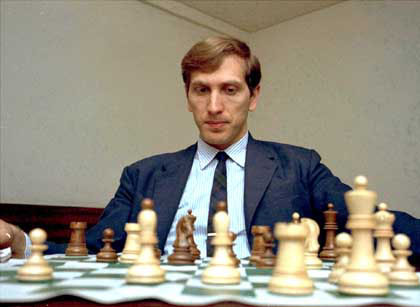
In Memoriam: Robert James "Bobby" Fischer (1943 - 2008)

The legacy of yesterday deceased chess grandmaster and world champion Bobby Fischer is remarkable in one particular aspect that the media do not recognize, and it is his engagement in non-aligned countries, especially in former Yugoslavia, the country of his choice for the 1972 world championship match with Boris Spassky. Although the actual match took place in Reykyavik, Iceland, with Fischer winning the title, the controversial 1992 re-match eventually took place at Sveti Stefan island in Montenegro and in Belgrade, Yugoslavia. Fischer’s refusal to obey instructions from the US Department of Treasury to drop participation due to US sanctions towards Federal Republic of Yugoslavia was the main reason for his subsequent life as fugitive for the US authorities and asylum seeker in several countries, of which Iceland granted him one in 2005.

Fischer’s visits to Yugoslavia in 1958, 1968 and in the seventies were given great attention by the Yugoslav media in terms of welcoming a western sportsman and intellectual who is supportive of the goal of Non-aligned Movement that Yugoslavia who, with president Josip Broz – Tito at the time, was a prominent and leading member country. After the refusal to accept the communist “Soviet way” in the early fifties, the Non-aligned Movement gave a chance to Yugoslavia to establish a historically important communication of one European country with the “third world” in the process of decolonization. Fischer’s visits to Belgrade, flooded with students and intellectuals from non-aligned countries were a critical point that made obvious that the “capitalist block” communicates very well in terms of the universal language such as chess. “Game of intellects” in the field of natural sciences and universal languages (with heavy accent on learning the new universal language – Esperanto) was a concept very much regarded in the socialist (not communist) Yugoslavia, where the late Marxism in the sixties acquired the critical mass in architecture, industry, culture, and in support to similar socialist projects in the world. On the political scale, the support was give to the emancipation of undeveloped countries in Africa and Asia, including the controversial Palestinian question. The academic and cultural exchange with Palestinians reduced the diplomatic relations with Israel to almost a zero. Bobby Fischer’s appearances in events sponsored by the Communist Party of Yugoslavia or by any state instance deemed to be supportive of either Vietnamese or Palestinian liberation movements, was perhaps the incentive for creation of his image as “anti-Semite”, especially bearing in mind that Fischer himself did not wrap up much what he had to say.

So, without further speculations of what might have been the cause for his alienation from the world that he came from, these lines are in the memory of a man who was expected to come to my home town at one occasion in the seventies, but due to appendix problems, he cancelled his visit to a chess championship here. Too bad, his visit could have spawned off some anecdotes…

R.I.P. Bobby Fischer

Wednesday, December 19, 2007

Eve of the War

A little revelation for me today. I finally found a song that I was whispering from time to time, without knowing the title or who the artist is. And yes, it has dawned on me, thanks to my friend Rade who is a meticulous seeker of pop culture stuff on the Internet. It is Jeff Wayne’s “Eve of the War”! Big thanks. You know, this is really a situation where search engines don’t help. How are you supposed to enter a keyword for something that you can only reproduce as music. Is this a good idea for an innovative search engine? Probably not.

There’s one thing that connects me strongly to this song. It was used as intro to a 1980’s Yugoslav sci-fi review show “Zvezdani ekran” (“Starry Screen”) hosted by Zoran Živković, the leading authority on science fiction in former Yugoslavia, later a big friend of Michael Moorcock and the most translated Serbian writer.

I watched the show in 1985 and 1986 usually some time at noon, before the school. I am sorry that the recorded shows are nowhere to be found, otherwise I would put the whole intro here, not just the music. The one below is from an animated series.

Yes, mid-eighties Graf! That was the time of those BBC documentaries, ones from Thames production. Wildlife shows like “Survival”. David Bellamy and wanders of nature somewhere around 10AM and then Zvezdani ekran. It was in that show that I saw a short sci-fi film "Quest" by Saul Bass based on a story by Ray Bradbury of the world where people live for only eight days and try to get out of that world for generations. One of my great impressions which is now decades old. It is another artefact of my TV life that I am lookin for...

Here's the video with Jeff Wayne's "Eve of the War" as a theme:

Wednesday, December 5, 2007

Sinister

Graf Oderland, thanks for the picture. However, it reminds of something that I thought about long ago, and that is how the cracks on the film really added some sinister look to the event. There is a lot of noise on the picture you placed as the header, and there is a strange feel I get from it. It is like in those dreams where you speak and the words come out distorted or with delay, or when you try to look at something, but the light is somehow too bright.

I found a video showing a footage of outer space taken from V-2 rocket in 1946. Our planet, that we are used to seeing as a pearl white ball with emerging blue and green, looks very sinister due to footage noise. What else to expect from a V-2?


Saturday, December 1, 2007

Fiddling with design

As you can see Zoran, I've started playing around a little bit with the look of the site, mostly to make it a little more interesting and easy on the eye. I've actually been meaning to do so for a while - had the image all chopped up and set to go. Finally got around to it on this chilly autumn Saturday morning.

Given our theme, and the fact that both your Pynchon and my Burke links touched on the V2, I thought it was apropos. And I liked the picture. Tell me what you think. And by all means, go in and fiddle with the settings/features yourself.

I'll continue my thought from a couple weeks ago presently.

Thursday, November 8, 2007

It's got EVERYTHING to do with your vorsprung durch technik, ya know?

A segue and homage in that post title; from the Britpop-inspired thoughts of my last response on Cool Britannia, via the cockney-caricature monologue of the real musical epitome of the era in all its pastiched, referential glory, Parklife, to the things I really want to talk about. Like epic scientific/historical documentaries, how we conceive of the course of history, technology's role in it, and the notion of specialized knowledge. And where that leads us, in turn. Sometimes in unanticipated directions.

It'll take me a few posts, spread over a few days (at my slovenly pace) to even scratch the surface of the connections (a pre-emptive pun) that I'm making. But here goes.

This summer, I discovered to my delight that someone has put virtually all of James Burke's major documentary series on the development of modern society, emphasizing science and technology, on Youtube. Thank you, "jamesburkefan." I'm not sure how familiar you are with Burke, Zoran - perhaps you are, perhaps not. But even if you're not, I've got the feeling you would recognize the feel and style of the documentaries he presents.

And what style! To say nothing of the content itself, which is quite awesome. These are the archetypal 70s-80s era BBC popular documentaries, as full of goodness as they are laden with dynamic, easily-parodied stylistic touches. The showy camerawork and cuts, for starters. It is all so nerdy, it can't help but be hip. Britain may have been going down the tubes in the late 1970s, but it couldn't have been all bad if they were capable of producing television like "Connections." Whiz-bang CGI special effects? Who needs those?* Spend the money instead on creating something worth saying, with enough left over for re-creations, round-the-world travels for the sake of a single shot, and one ubiquitous, fantastic off-white leisure suit. They don't make television like this anymore - or even show it much anymore, and that is a shame.

*Then again, the final moments of this episode are not special effects - and it's so much better than anything you could cook up on a computer. Talk about an astounding shot.

I had never seen all of the original Connections, nor most of his other series like The Day The Universe Changed. I've read that a couple of our "educational" cable channels (i.e. Discovery Channel, History Channel) may have shown some of these documentaries years ago, but nowadays they're more concerned with showing educational "documentaries" about custom motorcycle shops, UFOs and ghost hunters. So I've been slowly catching up with Burke on Youtube since late summer. An episode here, an episode there.

At several points, but especially here, in the finale, Burke talks about specialized knowledge in our modern world. And that is what I want to highlight, the idea that the further we go along, the more complex and recondite that knowledge gets (especially at the boundaries of science and technology), the more we all must depend on others, on "experts" and "expert interpretations" to make sense of it for us. Which leaves us extremely vulnerable to all sorts of manipulative things. Speaking as someone who considers himself somewhat intelligent, many intelligent, intellectually curious people are drawn to understanding things which, beyond a certain point, they just can't grasp in full. Stuff like quantum physics, superstring theory, and so on. I know that even the people working in those fields don't grasp it all. Yet we still want to know, and there are people claiming that it really means X, as if they grasp it all, as if it's a settled question. And this can have some political/cultural/environmental consequences. So who do we give creedence to?

I'll say more about this next time. It doesn't have much to do with Burke per se, more about things that interest me like the co-opting of certain near-impenetrable scientific ideas by certain New Age types.

We can talk all you want about James Burke - I would be glad to. He's still writing books by the cartload and heading up a curious project called the Knowledge Web, which seems to extend his basic perspective on history and historical figures - "everything is connected, often in ways you can't predict" - into a collaborative web space. It's a perspective that I find inspiring and provocative. But I would be remiss if I didn't also include this bit from one of his predecessors. Through a little research (I mean, wikipedia) I found that Burke's Connections was really just one in a line of big-picture-oriented historical documentaries produced by the Beeb in the 60s and 70s. Before him, there were projects like Jacob Bronowski's similar, but more highbrow and academic The Ascent Of Man.

Watch this clip. This is one of the more moving, meaningful and important few seconds of television I can remember seeing. Where Burke - not so much an academic, but a former TV science correspondent - tends to leaven the startling parts with a little whimsy and irony, this is pure drama and pathos. It chills. I can't get it out of my mind, the survivor stepping into the ash-puddle and "touching people." I wish that the clip didn't cut off when it did, and I'd like to hunt down the original series, probably on video somewhere but not in our library, to see the whole thing.

Jacob Bronowski at Auschwitz:


Friday, November 2, 2007

Cool Britannia

I mentioned squaddies in the previous post. Good reminder. It's exactly ten years since the expiration of my first ever employment contract. A one-year full-time job with British Forces in Bosnia as an interpreter. The year of 1996 was really something. Seventeen, straight from school, I got to meet the "lads" from Liverpool, Leeds, Lancaster...of whom many were my age. A rising generation of Cool Britannia who ended in shitholes of Bosnia as peacekeepers. I was ok with that, just changed one military service into another. Instead of doing a one year conscript service in domestic forces, I managed to join the peacekeepers and get paid for what I do.

Although the subsequent years brought me more in touch with the civil component of international presence in Bosnia, that eventually launched me overseas after the university, the first year was really "a first contact" of a sort. Stories of a rising club scene in England, photos of squaddies' naked girlfriends who sparked the imagination of a club night aftermath. It was also the year that Trainspotting was showing in cinemas.

Around the camps kiosks with pirate CDs mushroomed. Locals (who I also learned to call that way and later found out that it is a perfectly suitable depiction) got their first supplies then very expensive CD burners and made a fortune on burning fresh club music, Blur and Oasis for more "refined" ones. Noel Gallagher set against the background of improvised CD shops on main roads with lightly dressed girls and bunch of lads in their full combats making noise.

I wondered what happened with that generation of screw-ups of whom many went to army to avoid being sent to corrective facilities. Regardless of their past and family background, they looked the same under the Union Jack. A Generation, indeed.

Today I found an article on bbc.co.uk where some of them, probably not those who I met, but nevertheless them, talk about how Cool Britannia perished into the unfulfilled promise of labour with style that was supposed to build the true clubbing capital of the world.

Somewhere under the bed there's a Panasonic "boogie box" I bought "tax free for British Forces" in Sarajevo AAFI that first year. There are also those "near the main road CD shops" CDs somewhere too. It's different music for me these days, but I silently lament over that year of 1996 when Cool Britannia and British tax payers' money made me cooler in Bosnia than I would usually be. It would make the story too long if I started on how things went down almost in the same way that people in that BBC article describe it. As if the shift from the immediate post-war optimism in Bosnia followed the thought path of that generation of Britons of whom many ended in Afghanistan and Iraq, and slipped into the same undefinable state of mind as a cause of promises unfulfilled.

But, as I said, it would make the story a tad too long. Read the article.


Tuesday, October 30, 2007

Why the Balkans Attract Women

I remembered something from the book I read before:

Inventing Ruritania: The Imperialism of the Imagination
by Vesna Goldsworthy

“Through much of the nineteenth and twentieth centuries, writers and filmmakers in Western Europe and America have found in the Balkans a rich mine of images for literature and the movies. Bram Stoker's Transylvania and Anthony Hope's Ruritania are among the best known of these images. In this pioneering book, Vesna Goldsworthy explores the origins of the ideas that underpin Western perceptions of the "Wild East" region of Europe. She examines Western and East European letters, diaries, personal interviews, and a wide range of Balkan-inspired literature. She shows how the lucrative exploitation of Balkan history and geography for Western literature and for the entertainment industry has affected attitudes toward the countries of the region and the West's political involvement.” (Powells Review).

In a chapter with title “Why the Balkans Attract Women”, Goldsworthy refers to an unsigned article with the same title that appeared in 1912. in Graphic magazine. The question raised then and almost a century later by the author of Inventing Ruritania is “why those rough, wild, half civilized and half orientalized small countries attract some of the best women intellectuals?”. The unsigned article, as quoted by Goldsworthy, states that the East attracts women because in it's being it is female to the bone, as much as the West is male.

It can't get rid of the idea that the successor of Goldsworthy's Vicountess Strangford, Mary Adelaide Walker, Adelina Irby, Lady Hutton, Flora Sandes and other women who went to Balkans in the early 1900s, is, let's say, Christiane Amanpour. She did have fun in Sarajevo, but I'll leave her alone. A better example is an American anthropologist I met in Sarajevo at a conference couple years ago who conducted a research about the perception of civil society among the formerly opposed armies of Serbs, Croats and Bosniaks in Bosnia. I somehow know, at least from my experience as an interpreter for British Forces in Bosnia, that squaddies in all armies, everywhere in the world, think about just one thing – getting laid. She said that they were very cooperative when she went to visit them in the barracks and in the places where they hung out in free time (!) . The other one I met conducted a textual analysis, or something like that, of voting ballots at the far out polling posts during the several election years.

Now, the question raised here is whether is there is some king of fetish that Balkans satisfy in a safer and more discrete manner than elsewhere where shit has happened or is happening? Is it perhaps a case that, for instance, Bosnia still has something of that 19th century concept of a lost land, a place of refuge for the western pervert. A place where you can get lost? It's not my experience, I feel quite claustrophobic in this small country, but in a way that Bosnia is mediated, with two most sought war criminals still at large, and many of little pockets where all sorts of people hide, it may be the focus of some mild sort of orientalism. It's a four hour highway drive from Trieste to world's end.