
Monday, June 9, 2008
Blogging
Apropos of nothing, but for the fact that I ran across it today just as I'm thinking of turning up my blog production (here and in other places), here's a story on how the Information Economy is killing people.

Wednesday, February 27, 2008
Colin Wilson, the robot and peak experiences
A couple weeks ago I chatted with you about Colin Wilson – I didn’t know if you’d heard of him. Lately I’ve been reading some of his work – of which there is a ton, on subjects ranging from philosophy to crime to the occult and paranormal. (In fact it is always interesting to me how I “discover” new authors and new works either by chance or by following a string from one that I like to one I’ve never heard of; this is how I’ve come upon some of my biggest influences. Take Frisch, for example – my introduction to him came when I happened upon a movie adaptation of one of his novels on TV one evening.) In the case of
You can get a lot of stuff on
Maybe it’s no surprise that he remains utterly convinced of his own brilliance to this day, and of the lasting worth of his “New Existentialism” as a way of living, as laid out in his six-book Outsider cycle. Far be it from me to try and boil him down to a sentence or two, but here goes: he levels his attack upon Sartrean-style existentialism, and upon the whole pretext of much modern philosophy and culture, which is the assumption that life is basically meaningless. He refuses to believe this – regards it as psychologically sick, in fact - which is probably what infuriates so many in the intellectual set, and why I am attracted to reading him. There’s much more – his oeuvre is far too diverse and idiosyncratic to pigeonhole, which also makes him difficult to estimate. He entertains – apparently, even subscribes - to some of the more out-there notions having to do with prehistoric alien visitors and the whereabouts of Atlantis (I wonder about his thoughts on Hyperborea!); he has fixated on crime and criminology to the point that it seems like a bit of an obsession, and neither here nor there, he is open in his autobiography about his fetish for wearing women’s underwear. Well, to each his own.
I started reading
It seems that Maslow and Wilson carried on a correspondence, and it’s relatively easy to see how their interests and views on the psyche converge (more on that in a second). The first third of the book is an analysis of philosophy and early psychology, from Hume (whose skepticism Wilson is intensely skeptical of) through Freud and his contemporary followers like Jung and Adler, all of whom eventually made crucial breaks from “that Viennese quack” (copyright Vladimir Nabokov). The second part is a biography of Maslow himself, and the third section surveys some of the (then-contemporary) psychological theories inspired by or compatible with Maslowian psychology, especially Frankl (Man’s Search For Meaning).
Only they did not have the psychological understanding to know that at all. They were left to understand it as “inspiration” or “the muse” or something else entirely random. One of Wilson's points in The Outsider is that these outsider figures - such as Dostoevsky, Hesse, Hemingway, Van Gogh, Nijinsky - saw more and saw more deeply than the rest of the world, but after that, had a hard time answering the question "How to live?" No wonder they grew despondent when the ecstatic feeling passed, suffered tremendous mood swings chasing down “experience”, and often died young. You would too.
The other thing I can see is that it presages by some decades the positive psychology movement, which is now ensconced in the academy and in popular thought, as well as Czikszentmihalyi’s “flow” theories, which are related and which also have a lot of currency today.
A few assertions to be drawn from Maslow and Wilson, summarized as best as I can:
- The whole discipline of psychology post-Freud went out of whack because it concentrated only on bringing the pathologically mentally sick back to “normal,” instead of understanding the mind-ways of the most mentally healthy, fulfilled and resilient. (a firmly Maslowian point.) There was and is a need for study of the happiest, those whose mental economies are booming, so that we might understand what was going on and how others could be brought up to that higher level.
- “Peak experiences” can be cultivated and created at will (or close to it), and learning how to do this is the next important step for mentally healthy human beings to make. Will – the sustained effort of will – is vitally important. As is attention. As is attitude.
- We human beings are at our happiest and closest to “peaking” when our “mental pressure” is up, when we are pushed and/or pushing ourselves to our capacities, whether by external crisis or by deliberate acts of will. That is why we “lose ourselves” in times of incredible stress, and discover abilities and strengths we didn’t know we had. It is necessary to keep that mental pressure up, by force of will and attention (if our external surroundings don’t pressurize us enough.)
- Mental and physical health are tied together, and the ribbon is perhaps attitude.
As someone interested – no, I’d now say obsessed – with creativity, the muse, and figuring out how to live a life of relative, sustained happiness and creative work, I find this stuff compelling. I’ve read a lot of the popular literature on positive psychology and “flow” and it generally all fits together. What I get from Maslow is usually what I also get (in a more pop-psych form, perhaps) from today’s positive psychologists. On a totally different tack, I’ve thought about this, and the soldier friend you talked about – how it could be just as applicable to those in much more dangerous places than I ever go, maybe more so.
The thing about all this “peak” and “flow” – the arguably amoral thing – is that a person can legitimately find “flow” robbing a bank or sacking an enemy town or just existing on that edge I suppose you must live on in a war zone, as much as he can painting a painting or writing a sonnet or just washing the dishes, zen-master-like. (Czikszentmihalyi does make the point in one of his books that true “flow” experiences go towards some redeeming purpose…but why should they, other than for moral reasons?) If this is indeed a feature of the human psyche, that such mentally satisfying experiences need not always be altruistic or even good in nature (and I think it is true) then it seems a little harder to be terribly idealistic about peace – or at least, about collectively intellectualizing our way towards peace. As much as we would like that to be possible.
So via email I’ve sent you a file with passages I’ve copied out of NPIP (it’s my customary way of taking notes). There’s a ton of other stuff in there that is just as interesting, but that I missed.
For instance, here is
“…I elaborated this theory of the automatic pilot, speaking of it as ‘the robot.’ I wrote: ‘I am writing this on an electric typewriter. When I learned to type, I had to do it painfully and with much nervous wear and tear. But at a certain stage, a miracle occurred, and this complicated operation was ‘learned’ by a useful robot whom I conceal in my subconscious mind. Now I only have to think about what I want to say: my robot secretary does the typing. He is really very useful. He also drives the car for me, speaks French (not very well), and occasionally gives lectures in American universities.
He has one enormous disadvantage. If I discover a new symphony that moves me deeply, or a poem or a painting, this bloody robot promptly insists on getting in on the act. And when I listen to this symphony for the third time, he begins to anticipate every note. He begins to listen to it automatically, and I lose all the pleasure.”
Later:
“The robot is necessary. Without him, the wear and tear of everyday life would exhaust us within minutes. But he also acts as a filter that cuts out the freshness, the newness, of everyday life….in developing the robot, we have solved one enormous problem – and created another. But there is, after all, no reason why we should not solve that too: modify the robot until he admits the necessary amount of ‘newness’, while still taking over the menial tasks.”
The key, it seems, is to gain control of this robot, to not let it run amuck in our lives. This is “mindfulness,” in other words, and that concept is thousands of years old. Yet most people let their robot run most or all of their lives, and that is the source of much unhappiness. The part about “modifying the robot” points at nothing less than psychological evolution, which is in fact an assumption that Wilson (and Maslow) would make – that the human psyche is capable of evolving and improving through time, learning and effort. That we have not even come close to maximizing its potential. The whole point of this psychological outlook, and of this “existentialism” is that there is a way to do so; as
Here's a little Colin Wilson on peak experiences, on Youtube:
Friday, January 18, 2008
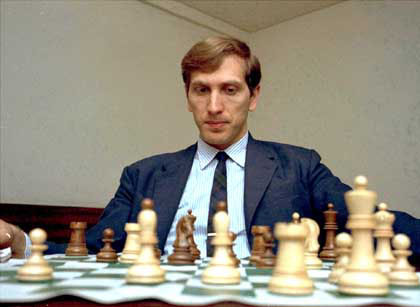
In Memoriam: Robert James "Bobby" Fischer (1943 - 2008)
The legacy of yesterday deceased chess grandmaster and world champion Bobby Fischer is remarkable in one particular aspect that the media do not recognize, and it is his engagement in non-aligned countries, especially in former Yugoslavia, the country of his choice for the 1972 world championship match with Boris Spassky. Although the actual match took place in Reykyavik, Iceland, with Fischer winning the title, the controversial 1992 re-match eventually took place at Sveti Stefan island in Montenegro and in Belgrade, Yugoslavia. Fischer’s refusal to obey instructions from the US Department of Treasury to drop participation due to US sanctions towards Federal Republic of Yugoslavia was the main reason for his subsequent life as fugitive for the US authorities and asylum seeker in several countries, of which Iceland granted him one in 2005.
Fischer’s visits to Yugoslavia in 1958, 1968 and in the seventies were given great attention by the Yugoslav media in terms of welcoming a western sportsman and intellectual who is supportive of the goal of Non-aligned Movement that Yugoslavia who, with president Josip Broz – Tito at the time, was a prominent and leading member country. After the refusal to accept the communist “Soviet way” in the early fifties, the Non-aligned Movement gave a chance to Yugoslavia to establish a historically important communication of one European country with the “third world” in the process of decolonization. Fischer’s visits to Belgrade, flooded with students and intellectuals from non-aligned countries were a critical point that made obvious that the “capitalist block” communicates very well in terms of the universal language such as chess. “Game of intellects” in the field of natural sciences and universal languages (with heavy accent on learning the new universal language – Esperanto) was a concept very much regarded in the socialist (not communist) Yugoslavia, where the late Marxism in the sixties acquired the critical mass in architecture, industry, culture, and in support to similar socialist projects in the world. On the political scale, the support was give to the emancipation of undeveloped countries in Africa and Asia, including the controversial Palestinian question. The academic and cultural exchange with Palestinians reduced the diplomatic relations with Israel to almost a zero. Bobby Fischer’s appearances in events sponsored by the Communist Party of Yugoslavia or by any state instance deemed to be supportive of either Vietnamese or Palestinian liberation movements, was perhaps the incentive for creation of his image as “anti-Semite”, especially bearing in mind that Fischer himself did not wrap up much what he had to say.
So, without further speculations of what might have been the cause for his alienation from the world that he came from, these lines are in the memory of a man who was expected to come to my home town at one occasion in the seventies, but due to appendix problems, he cancelled his visit to a chess championship here. Too bad, his visit could have spawned off some anecdotes…
R.I.P. Bobby Fischer
The legacy of yesterday deceased chess grandmaster and world champion Bobby Fischer is remarkable in one particular aspect that the media do not recognize, and it is his engagement in non-aligned countries, especially in former Yugoslavia, the country of his choice for the 1972 world championship match with Boris Spassky. Although the actual match took place in Reykyavik, Iceland, with Fischer winning the title, the controversial 1992 re-match eventually took place at Sveti Stefan island in Montenegro and in Belgrade, Yugoslavia. Fischer’s refusal to obey instructions from the US Department of Treasury to drop participation due to US sanctions towards Federal Republic of Yugoslavia was the main reason for his subsequent life as fugitive for the US authorities and asylum seeker in several countries, of which Iceland granted him one in 2005.
Fischer’s visits to Yugoslavia in 1958, 1968 and in the seventies were given great attention by the Yugoslav media in terms of welcoming a western sportsman and intellectual who is supportive of the goal of Non-aligned Movement that Yugoslavia who, with president Josip Broz – Tito at the time, was a prominent and leading member country. After the refusal to accept the communist “Soviet way” in the early fifties, the Non-aligned Movement gave a chance to Yugoslavia to establish a historically important communication of one European country with the “third world” in the process of decolonization. Fischer’s visits to Belgrade, flooded with students and intellectuals from non-aligned countries were a critical point that made obvious that the “capitalist block” communicates very well in terms of the universal language such as chess. “Game of intellects” in the field of natural sciences and universal languages (with heavy accent on learning the new universal language – Esperanto) was a concept very much regarded in the socialist (not communist) Yugoslavia, where the late Marxism in the sixties acquired the critical mass in architecture, industry, culture, and in support to similar socialist projects in the world. On the political scale, the support was give to the emancipation of undeveloped countries in Africa and Asia, including the controversial Palestinian question. The academic and cultural exchange with Palestinians reduced the diplomatic relations with Israel to almost a zero. Bobby Fischer’s appearances in events sponsored by the Communist Party of Yugoslavia or by any state instance deemed to be supportive of either Vietnamese or Palestinian liberation movements, was perhaps the incentive for creation of his image as “anti-Semite”, especially bearing in mind that Fischer himself did not wrap up much what he had to say.
So, without further speculations of what might have been the cause for his alienation from the world that he came from, these lines are in the memory of a man who was expected to come to my home town at one occasion in the seventies, but due to appendix problems, he cancelled his visit to a chess championship here. Too bad, his visit could have spawned off some anecdotes…
R.I.P. Bobby Fischer
Wednesday, December 19, 2007
Eve of the War
A little revelation for me today. I finally found a song that I was whispering from time to time, without knowing the title or who the artist is. And yes, it has dawned on me, thanks to my friend Rade who is a meticulous seeker of pop culture stuff on the Internet. It is Jeff Wayne’s “Eve of the War”! Big thanks. You know, this is really a situation where search engines don’t help. How are you supposed to enter a keyword for something that you can only reproduce as music. Is this a good idea for an innovative search engine? Probably not.
There’s one thing that connects me strongly to this song. It was used as intro to a 1980’s Yugoslav sci-fi review show “Zvezdani ekran” (“Starry Screen”) hosted by Zoran Živković, the leading authority on science fiction in former Yugoslavia, later a big friend of Michael Moorcock and the most translated Serbian writer.
I watched the show in 1985 and 1986 usually some time at noon, before the school. I am sorry that the recorded shows are nowhere to be found, otherwise I would put the whole intro here, not just the music. The one below is from an animated series.
Yes, mid-eighties Graf! That was the time of those BBC documentaries, ones from Thames production. Wildlife shows like “Survival”. David Bellamy and wanders of nature somewhere around 10AM and then Zvezdani ekran. It was in that show that I saw a short sci-fi film "Quest" by Saul Bass based on a story by Ray Bradbury of the world where people live for only eight days and try to get out of that world for generations. One of my great impressions which is now decades old. It is another artefact of my TV life that I am lookin for...
Here's the video with Jeff Wayne's "Eve of the War" as a theme:
There’s one thing that connects me strongly to this song. It was used as intro to a 1980’s Yugoslav sci-fi review show “Zvezdani ekran” (“Starry Screen”) hosted by Zoran Živković, the leading authority on science fiction in former Yugoslavia, later a big friend of Michael Moorcock and the most translated Serbian writer.
I watched the show in 1985 and 1986 usually some time at noon, before the school. I am sorry that the recorded shows are nowhere to be found, otherwise I would put the whole intro here, not just the music. The one below is from an animated series.
Yes, mid-eighties Graf! That was the time of those BBC documentaries, ones from Thames production. Wildlife shows like “Survival”. David Bellamy and wanders of nature somewhere around 10AM and then Zvezdani ekran. It was in that show that I saw a short sci-fi film "Quest" by Saul Bass based on a story by Ray Bradbury of the world where people live for only eight days and try to get out of that world for generations. One of my great impressions which is now decades old. It is another artefact of my TV life that I am lookin for...
Here's the video with Jeff Wayne's "Eve of the War" as a theme:
Wednesday, December 5, 2007
Sinister
Graf Oderland, thanks for the picture. However, it reminds of something that I thought about long ago, and that is how the cracks on the film really added some sinister look to the event. There is a lot of noise on the picture you placed as the header, and there is a strange feel I get from it. It is like in those dreams where you speak and the words come out distorted or with delay, or when you try to look at something, but the light is somehow too bright.
I found a video showing a footage of outer space taken from V-2 rocket in 1946. Our planet, that we are used to seeing as a pearl white ball with emerging blue and green, looks very sinister due to footage noise. What else to expect from a V-2?
I found a video showing a footage of outer space taken from V-2 rocket in 1946. Our planet, that we are used to seeing as a pearl white ball with emerging blue and green, looks very sinister due to footage noise. What else to expect from a V-2?
Saturday, December 1, 2007
Fiddling with design
As you can see Zoran, I've started playing around a little bit with the look of the site, mostly to make it a little more interesting and easy on the eye. I've actually been meaning to do so for a while - had the image all chopped up and set to go. Finally got around to it on this chilly autumn Saturday morning.
Given our theme, and the fact that both your Pynchon and my Burke links touched on the V2, I thought it was apropos. And I liked the picture. Tell me what you think. And by all means, go in and fiddle with the settings/features yourself.
I'll continue my thought from a couple weeks ago presently.
Given our theme, and the fact that both your Pynchon and my Burke links touched on the V2, I thought it was apropos. And I liked the picture. Tell me what you think. And by all means, go in and fiddle with the settings/features yourself.
I'll continue my thought from a couple weeks ago presently.
Thursday, November 8, 2007
It's got EVERYTHING to do with your vorsprung durch technik, ya know?
A segue and homage in that post title; from the Britpop-inspired thoughts of my last response on Cool Britannia, via the cockney-caricature monologue of the real musical epitome of the era in all its pastiched, referential glory, Parklife, to the things I really want to talk about. Like epic scientific/historical documentaries, how we conceive of the course of history, technology's role in it, and the notion of specialized knowledge. And where that leads us, in turn. Sometimes in unanticipated directions.
It'll take me a few posts, spread over a few days (at my slovenly pace) to even scratch the surface of the connections (a pre-emptive pun) that I'm making. But here goes.
This summer, I discovered to my delight that someone has put virtually all of James Burke's major documentary series on the development of modern society, emphasizing science and technology, on Youtube. Thank you, "jamesburkefan." I'm not sure how familiar you are with Burke, Zoran - perhaps you are, perhaps not. But even if you're not, I've got the feeling you would recognize the feel and style of the documentaries he presents.
And what style! To say nothing of the content itself, which is quite awesome. These are the archetypal 70s-80s era BBC popular documentaries, as full of goodness as they are laden with dynamic, easily-parodied stylistic touches. The showy camerawork and cuts, for starters. It is all so nerdy, it can't help but be hip. Britain may have been going down the tubes in the late 1970s, but it couldn't have been all bad if they were capable of producing television like "Connections." Whiz-bang CGI special effects? Who needs those?* Spend the money instead on creating something worth saying, with enough left over for re-creations, round-the-world travels for the sake of a single shot, and one ubiquitous, fantastic off-white leisure suit. They don't make television like this anymore - or even show it much anymore, and that is a shame.
*Then again, the final moments of this episode are not special effects - and it's so much better than anything you could cook up on a computer. Talk about an astounding shot.
I had never seen all of the original Connections, nor most of his other series like The Day The Universe Changed. I've read that a couple of our "educational" cable channels (i.e. Discovery Channel, History Channel) may have shown some of these documentaries years ago, but nowadays they're more concerned with showing educational "documentaries" about custom motorcycle shops, UFOs and ghost hunters. So I've been slowly catching up with Burke on Youtube since late summer. An episode here, an episode there.
At several points, but especially here, in the finale, Burke talks about specialized knowledge in our modern world. And that is what I want to highlight, the idea that the further we go along, the more complex and recondite that knowledge gets (especially at the boundaries of science and technology), the more we all must depend on others, on "experts" and "expert interpretations" to make sense of it for us. Which leaves us extremely vulnerable to all sorts of manipulative things. Speaking as someone who considers himself somewhat intelligent, many intelligent, intellectually curious people are drawn to understanding things which, beyond a certain point, they just can't grasp in full. Stuff like quantum physics, superstring theory, and so on. I know that even the people working in those fields don't grasp it all. Yet we still want to know, and there are people claiming that it really means X, as if they grasp it all, as if it's a settled question. And this can have some political/cultural/environmental consequences. So who do we give creedence to?
I'll say more about this next time. It doesn't have much to do with Burke per se, more about things that interest me like the co-opting of certain near-impenetrable scientific ideas by certain New Age types.
We can talk all you want about James Burke - I would be glad to. He's still writing books by the cartload and heading up a curious project called the Knowledge Web, which seems to extend his basic perspective on history and historical figures - "everything is connected, often in ways you can't predict" - into a collaborative web space. It's a perspective that I find inspiring and provocative. But I would be remiss if I didn't also include this bit from one of his predecessors. Through a little research (I mean, wikipedia) I found that Burke's Connections was really just one in a line of big-picture-oriented historical documentaries produced by the Beeb in the 60s and 70s. Before him, there were projects like Jacob Bronowski's similar, but more highbrow and academic The Ascent Of Man.
Watch this clip. This is one of the more moving, meaningful and important few seconds of television I can remember seeing. Where Burke - not so much an academic, but a former TV science correspondent - tends to leaven the startling parts with a little whimsy and irony, this is pure drama and pathos. It chills. I can't get it out of my mind, the survivor stepping into the ash-puddle and "touching people." I wish that the clip didn't cut off when it did, and I'd like to hunt down the original series, probably on video somewhere but not in our library, to see the whole thing.
Jacob Bronowski at Auschwitz:
It'll take me a few posts, spread over a few days (at my slovenly pace) to even scratch the surface of the connections (a pre-emptive pun) that I'm making. But here goes.
This summer, I discovered to my delight that someone has put virtually all of James Burke's major documentary series on the development of modern society, emphasizing science and technology, on Youtube. Thank you, "jamesburkefan." I'm not sure how familiar you are with Burke, Zoran - perhaps you are, perhaps not. But even if you're not, I've got the feeling you would recognize the feel and style of the documentaries he presents.
And what style! To say nothing of the content itself, which is quite awesome. These are the archetypal 70s-80s era BBC popular documentaries, as full of goodness as they are laden with dynamic, easily-parodied stylistic touches. The showy camerawork and cuts, for starters. It is all so nerdy, it can't help but be hip. Britain may have been going down the tubes in the late 1970s, but it couldn't have been all bad if they were capable of producing television like "Connections." Whiz-bang CGI special effects? Who needs those?* Spend the money instead on creating something worth saying, with enough left over for re-creations, round-the-world travels for the sake of a single shot, and one ubiquitous, fantastic off-white leisure suit. They don't make television like this anymore - or even show it much anymore, and that is a shame.
*Then again, the final moments of this episode are not special effects - and it's so much better than anything you could cook up on a computer. Talk about an astounding shot.
I had never seen all of the original Connections, nor most of his other series like The Day The Universe Changed. I've read that a couple of our "educational" cable channels (i.e. Discovery Channel, History Channel) may have shown some of these documentaries years ago, but nowadays they're more concerned with showing educational "documentaries" about custom motorcycle shops, UFOs and ghost hunters. So I've been slowly catching up with Burke on Youtube since late summer. An episode here, an episode there.
At several points, but especially here, in the finale, Burke talks about specialized knowledge in our modern world. And that is what I want to highlight, the idea that the further we go along, the more complex and recondite that knowledge gets (especially at the boundaries of science and technology), the more we all must depend on others, on "experts" and "expert interpretations" to make sense of it for us. Which leaves us extremely vulnerable to all sorts of manipulative things. Speaking as someone who considers himself somewhat intelligent, many intelligent, intellectually curious people are drawn to understanding things which, beyond a certain point, they just can't grasp in full. Stuff like quantum physics, superstring theory, and so on. I know that even the people working in those fields don't grasp it all. Yet we still want to know, and there are people claiming that it really means X, as if they grasp it all, as if it's a settled question. And this can have some political/cultural/environmental consequences. So who do we give creedence to?
I'll say more about this next time. It doesn't have much to do with Burke per se, more about things that interest me like the co-opting of certain near-impenetrable scientific ideas by certain New Age types.
We can talk all you want about James Burke - I would be glad to. He's still writing books by the cartload and heading up a curious project called the Knowledge Web, which seems to extend his basic perspective on history and historical figures - "everything is connected, often in ways you can't predict" - into a collaborative web space. It's a perspective that I find inspiring and provocative. But I would be remiss if I didn't also include this bit from one of his predecessors. Through a little research (I mean, wikipedia) I found that Burke's Connections was really just one in a line of big-picture-oriented historical documentaries produced by the Beeb in the 60s and 70s. Before him, there were projects like Jacob Bronowski's similar, but more highbrow and academic The Ascent Of Man.
Watch this clip. This is one of the more moving, meaningful and important few seconds of television I can remember seeing. Where Burke - not so much an academic, but a former TV science correspondent - tends to leaven the startling parts with a little whimsy and irony, this is pure drama and pathos. It chills. I can't get it out of my mind, the survivor stepping into the ash-puddle and "touching people." I wish that the clip didn't cut off when it did, and I'd like to hunt down the original series, probably on video somewhere but not in our library, to see the whole thing.
Jacob Bronowski at Auschwitz:
Subscribe to:
Posts (Atom)